
“In the off-season you just want to get better,” says Tiger-Cats quarterback Zach Collaros, and by all accounts, that is exactly what the young quarterback spent his time doing this off-season.
Collaros had considerable success at the helm of the Ticats’ offence last season, leading the team to an 8-3 record down the stretch, including two losses that could have easily been wins.
The 26-year old completed 66.8% of his passes in that stretch following Labour Day, throwing for 277 yards per game while rushing for an additional 28 yards per game on the ground. Over that 11-game stretch heading into the playoffs, Collaros threw for 14 touchdowns and just seven interceptions, while rushing for an additional two touchdowns.
Yet despite that proficiency, the outlook appears even brighter for Collaros in the new season thanks to the work he put in over the course of the off-season.
“Going back and watching the film, I talked with Tommy [Condell] and Kent [Austin] and found some deficiencies,” says Collaros, “I read up on some stuff and got some advice from those guys, and just worked at it every day.”
Collaros was effective in 2014, but he was still gaining an understanding of the deeper nuances of the Ticats’ offence. Now, with a full off-season of studying and 13 games in the system under his belt, he feels much more confident about what he’s doing, and that starts with knowing what everyone else is doing.
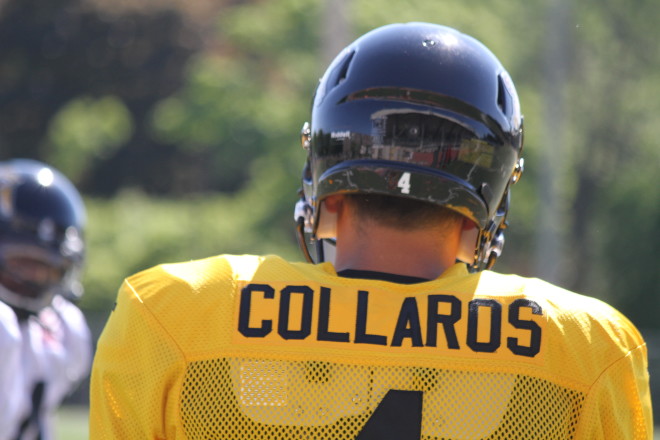
“I have better chemistry with the guys, they know what to expect from me, I know what to expect from them,” explains Collaros. “Any time you can get to that level, where everybody trusts each other to do their jobs, you’re going to be a better football team.”
Offensive coordinator Tommy Condell, echoing his quarterback, says that Collaros’ main improvement has been his understanding of the playbook, which has allowed him to concentrate more on fundamentals and technique.
“His eye fixes and eye scans are much quicker, so he’s able to get his body into position to throw a lot better,” says Condell, adding that the improvements all come back to Collaros’ dedication to studying the game.
His offensive coordinator is not the only coach that Collaros has impressed; head coach Kent Austin is very happy with what he’s seen from the second-year starter since he arrived at camp.
“Things are slower for him,” says Austin, “which means it’s faster in his processing.”
According to Austin, Collaros benefits from what he calls a “tremendous recall”, something that has made him a key contributor in the classroom, and a better player on the field.
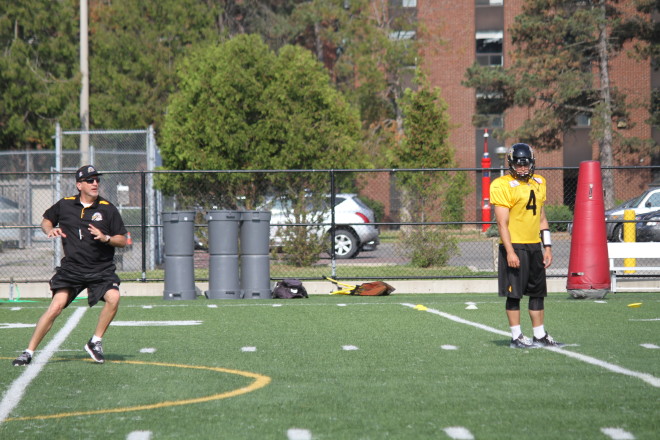
“As we continue to install things from last year, he’s had a tremendous recall on how to execute it,” expands Austin, “[he knows] which concept it is, what category it falls under, and what his directional reads and progressional reads are.”
It would be reasonable to think that Collaros’ increased knowledge of the offence may reduce the need to create plays on the fly; however, coach Condell explains that this is probably not the case, because these types of plays are not all outside of the plan.
“We call it the ‘jazz session’,” he says. “There is a little improvisation, but there is a structure that needs to be defined, worked and we need to make sure we do the fundamentals within that play.”
He explains that once a play breaks down, it does not become a free-for-all out there; instead, the team simply moves onto the ‘jazz session’, in which the players still have loosely structured roles to play. It’s a necessity to structure in those types of plays when you’ve got an athlete who can do what Collaros does, says Condell, but it still requires a plan.
Collaros gives credit to the veteran players around him, guys like Bakari Grant and Andy Fantuz, for knowing how to get open in those situations and says that the team will be ready when those situations present themselves again this season.
“We were able to move the chains with it last year and score some touchdowns,” says the Ticats quarterback, “when it’s needed we’ve done a good job with it and we’re just going to continue to improve.”