In the season’s sixth edition of the ‘Film Room’ series, we’re going to break down Ticats receiver Terrell Sinkfield’s touchdown reception against the Roughriders. Sinkfield’s 87-yard touchdown was the longest reception in the CFL this season, as well as the longest play from scrimmage.
Situation:
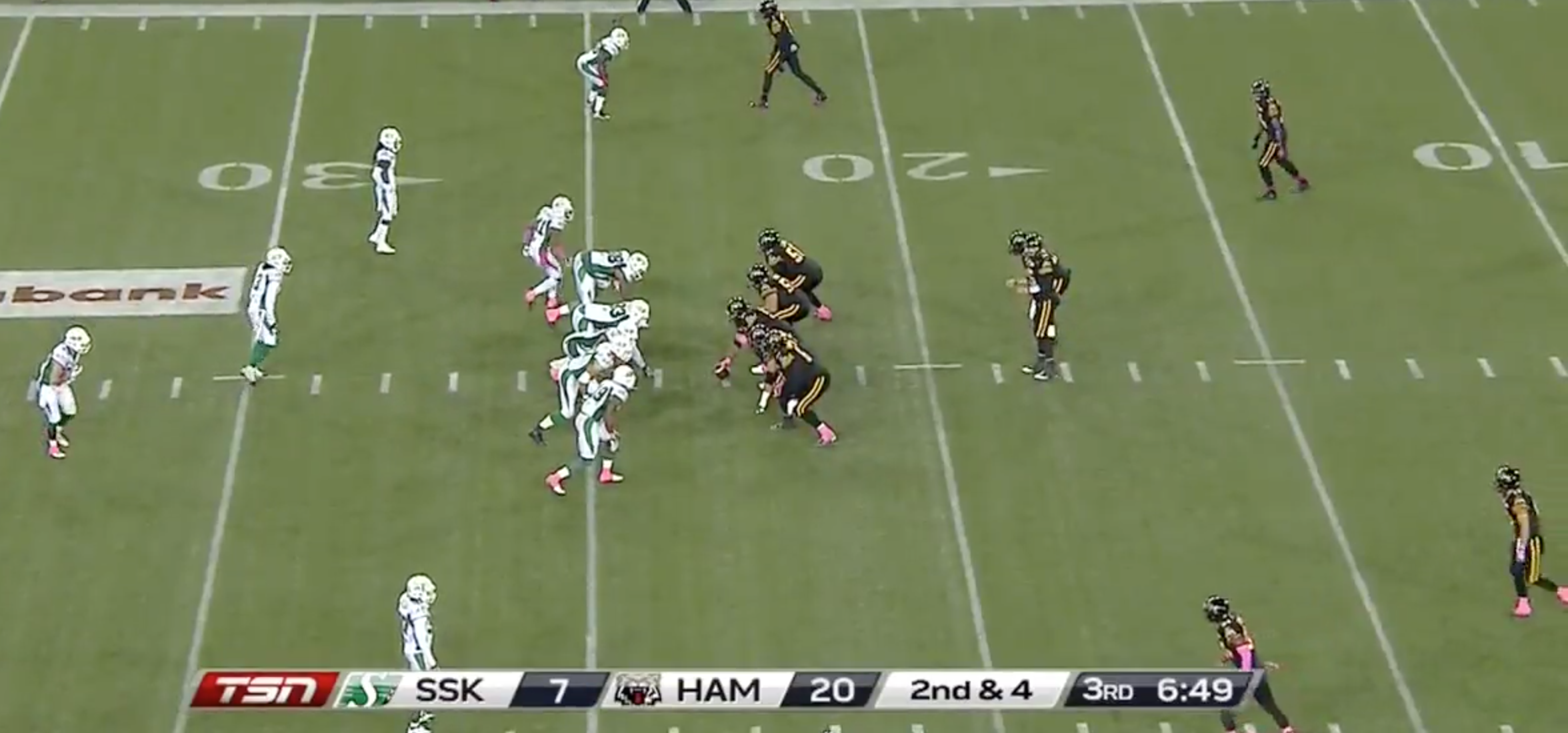
The play came on the Tiger-Cats ninth offensive drive of the game, their second consecutive offensive drive. The drive, which began at the Hamilton 17-yard line, lasted just two plays and traveled a total of 93 yards. The previous play was a 6-yard passing play to Bakari Grant, leaving the Ticats with 2nd-and-4 from their own 23-yard line.
Pre-Snap:
The Ticats lined up on the play with Tiquan Underwood wide right and Giovanni Aprile wide left. Inside of Aprile, Bakari Grant (outside slot) and Luke Tasker (inside slot) both began from the waggle, Tasker slightly staggered behind Grant. Terrell Sinkfield, the focus of the play, lined up at the same depth as Tasker on the right side of the field.
Michael Ford was positioned to the right of quarterback Jeff Mathews, who lined up in shotgun formation.
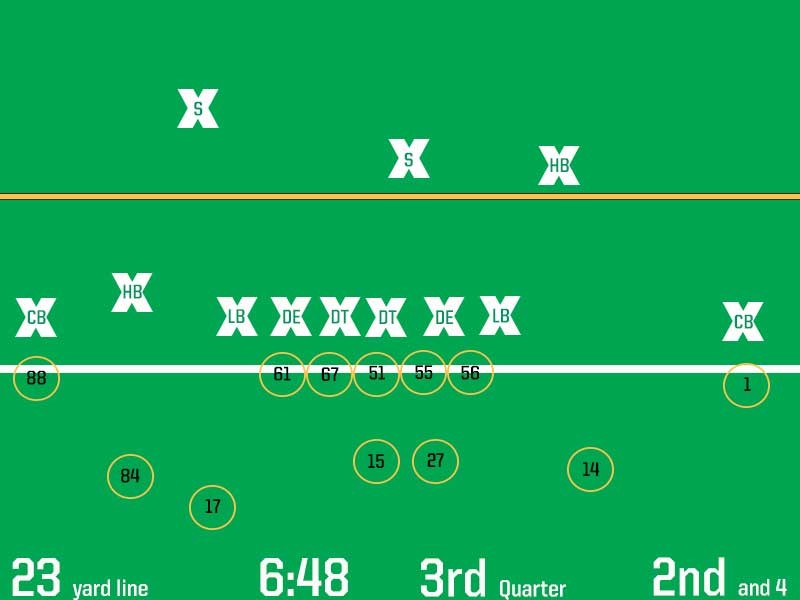
On the other side of the ball, the Riders showed pre-snap pressure with six defenders lined up one yard off the ball and another two defensive backs in the box at the snap of the ball. Whether they were predicting a run on second-and-short or hoping to force a mistake from Mathews, the Riders did not disguise the added pressure.
In the secondary, the boundary and field corners lined up in press-man coverage, while the remaining defensive backs aligned in off-coverage across from the slot receivers.
Sinkfield’s perspective: “We just saw that the blitz was coming, so we went to our blitz read. We knew that little hole would be open off of their blitz, so I just had to be hot for the quarterback and make sure I had my hands and eyes ready for him as an outlet.”
The Play:
Prior to the snap the Ticats identified the Riders’ blitz and changed the receivers’ original patterns to counter-act the added pass rushers. Off the snap, Mathews dropped into a quick one-step drop, taking a single step before planting and throwing the ball to Sinkfield.
The Ticats read the blitz correctly, as the Riders sent seven pass rushers on the play, including the safety who dropped down into the box as the ball was snapped. The Ticats offensive line held up against the blitz, giving Mathews a sufficient pocket to set and throw from; running back Michael Ford identified the blitzing linebacker and picked him up in pass protection.
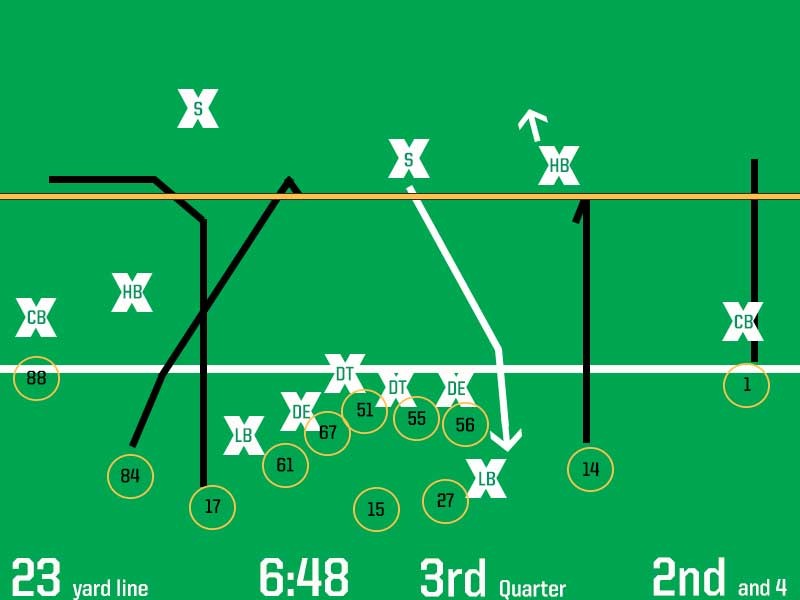
Sinkfield’s original route was abandoned in favour of a quick five-yard curl. Riders halfback Marshay Green back-pedalled aggressively in coverage, showing respect for the Ticats receiver’s speed. By the time Sinkfield turned back for the ball, Green was on his heels and had backed off too far to recover and break up the play.
Mathews’ throw arrived in Sinkfield’s hands in perfect timing; as he turned to locate the ball, the pass had already been released and was in his hands immediately. The placement of the throw– on the receiver’s outside shoulder– was critical to the situation as it allowed Sinkfield to continue his motion without losing a step. If the ball had been thrown inside, the receiver would have been forced to slow down and the play would likely have resulted in a much shorter gain.
Sinkfield caught the ball on his outside shoulder and turned in stride, sliding right throw Marshay Green’s outstretched arms on the tackle. Because Green backed off so quickly, he was forced to overcompensate when coming back to the ball, sending him flying past Sinkfield rather than setting his feet and making a form tackle.
-Click photo to see play-
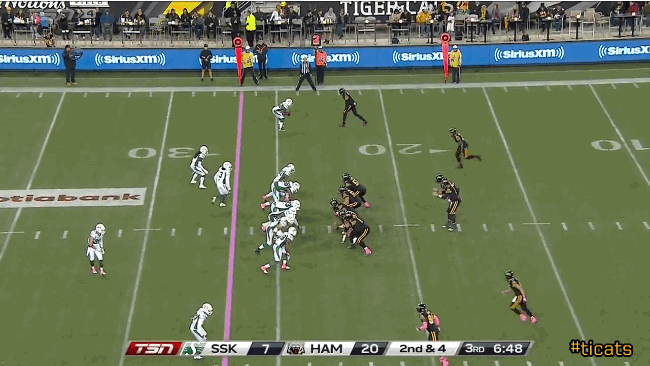
The Riders choice to send their safety on the blitz here backfired, as it meant that there was no deep support behind Marshay Green. Once Sinkfield caught the ball and broke the tackle, the Ticats receiver’s top-end speed took over and he was off to the races. Sinkfield is well-known for his unofficial 40-yard dash time of 4.19 seconds, so it is no surprise that he outraced the opposition on the way to the Riders end zone.
Sinkfield’s perspective: “I was literally just looking straight ahead and I was telling ‘do not fall’, for real, that’s the only thing I was thinking. I stumbled when I first took off, I’m like ‘do not fall, Terrell, you are wide open right now’.”
According to our timer, Sinkfield topped his own lofty standards in the 40-yard dash, closing the 40-yard gap between the Ticats 40-yard line and the Riders 30-yard line in 4.14 seconds.
Needing just 4.14 seconds to cover that distance is an impressive feat on its’ own, but considering the fact that most of the Riders defenders (and Sinkfield himself) had slowed down by the time he got to the opposite 30-yard line, there’s no telling whether that’s even the fastest time he could run.
Sinkfield’s perspective: “4.14 seconds? That’s pretty fast. I tried to show some speed out there.”
