“When I walked off the field for my last game, I dropped the ball and never looked back,” said John Barrow, Tiger-Cats legend.
If Barrow were to look back on his football career, there would be a lot to take in: 14 seasons, 11 all-star nods, Hall of Fame induction, Wall of Honour induction, and the title Lineman of the Century.
Barrow was part of the greatest front four in Tiger-Cats history, rubbing shoulders with Angelo Mosca during the team’s 1960s dynasty. What is most impressive about Barrow’s legacy however, is his versatility. Barrow was not only an all-star defensive end, but is also widely regarded the greatest left tackle in the history of the franchise.
Perhaps Barrow was simply born a true athlete, and his natural skillset allowed him to be a standout player in a star-studded era, or perhaps there was something unique about his game that fostered his success. Maybe, playing on both sides of the ball, and living inside the mind of his adversaries, gave him an edge. Maybe, his success can be replicated.
This season, there are three players on the Tiger-Cats roster that are transitioning from defensive line to offensive line. The players, Everton Williams, Kay Okafor, and Mathieu Dupuis, have a lot in common. All are tremendous athletes willing to overcome challenges, and all have a deep passion for the game of football. Under the careful tutelage of the Tiger-Cats coaching staff, the players are slowly reversing deeply engrained football habits as they develop into a unique crop of young offensive lineman.
Williams has been with the team the longest of the three, having been a Tiger-Cat since before the 2015 season. He converted to the Tiger-Cats offensive line during training camp that year and has been growing into the position ever since. Moving around the field isn’t a foreign concept to Williams; growing up he played every position from punter, to receiver, to defensive end. His vagrant history may have eased the adjustment, but converting positions is a greater challenge at the professional level.
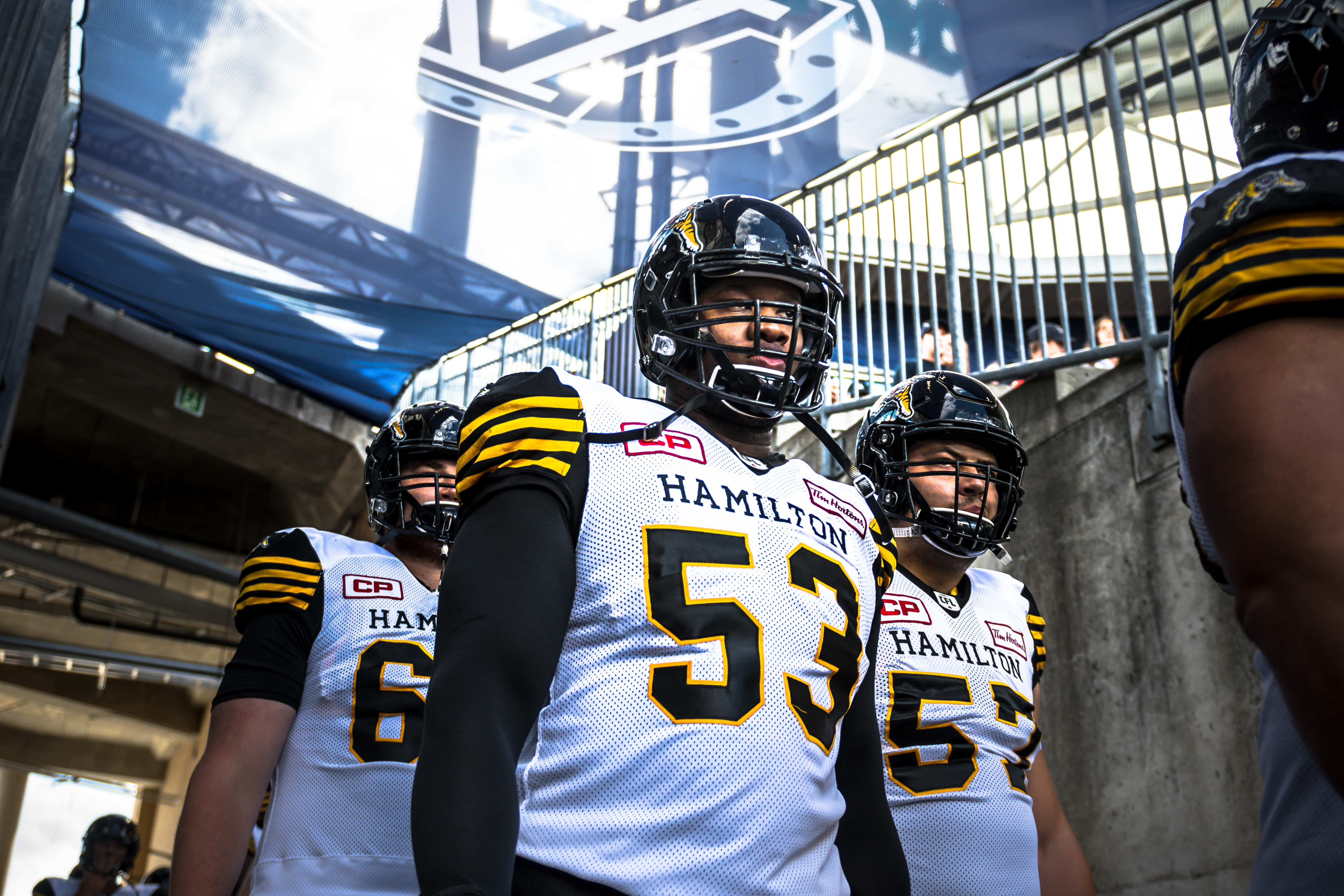
“The most difficult part was being aggressive and being patient at the same time. The defensive line is a different beast. It’s one of those things where you run onto the field yelling. Offensive line is the same thing mentally, but if you try to overextend or lunge, you’ll find very quickly that it’s impossible to stay in front of your man. For me it was tough to understand controlled aggression,” says Williams.
After just two years in his new position, Williams already regards defense as a thing of the past. For the other two recent converts, the defensive line isn’t such a distant memory.
Kay Okafor, the Tiger-Cats third round pick in this year’s draft, is still adjusting mentally.
“You have to be mentally in check the whole game. On the defensive line you have to be mentally in check as well, but it’s at a different level with offense. You have to know the count, know the play, know what the defense is doing – it’s just a whole new position,” says Okafor.
The conversion between the two positions certainly isn’t as simple as crossing the line of scrimmage. An offensive lineman knows when the play is underway based on the snap count, whereas a defensive lineman’s attack is triggered by the movement of the ball. The role of each offensive lineman is dictated by the play call, and conversely a defensive lineman is responsible for shooting his assigned gap. Neither position is more difficult. They’re just difficult in significantly different ways.
Dupuis, an Ottawa Redblacks draft pick that recently signed with the Tiger-Cats, echoes his teammates by listing the snap count, the expanded playbook, and the foreign body positioning as the biggest adjustments.
“As the offensive line, your weight needs to be on your heels and inside your feet,” says Dupuis. “As the defensive line, your weight needs to be on your toes, and boom! You’re like a horse, you know. Weight distribution is different.”
These obstacles were all faced and expertly overcome by Barrow many decades ago. Barrow’s illustrious career is a testament to the benefits that may be reaped from the conversion.
“I think I have a better understanding of what defenses, especially defensive lineman, are trying to do to me. Knowing what’s coming helps me out with reading my schemes,” says Williams.
And it isn’t just Williams that feels his defensive heritage benefits him in his new position. Okafor and Dupuis agree.
“I know what I like when I’m playing as a defensive lineman. If the offensive lineman gave me his head or something like that, I would probably have just pushed, or pulled. So what I do now is different than the things I used to like when I was a defensive lineman,” says an animated Dupuis. “It helps because I know what they’re thinking and I know how they’re going to react to what I’m doing.”
On the practice roster the Ticats are building an offensive line of the future, with a strategy proven in the past.
Each of the young Tiger-Cats has the potential to pick up the ball where John Barrow left it.
- Labour Day Classic
- Content & News
- Tickets
- Schedule
- Team
- Gameday
- Shop
- MyTix
- Community & Events