Hamilton and the Hall: The 2017 Canadian Football Hall of Fame Induction Class and its Link to the Hamilton Tiger-Cats
The Canadian Football Hall of Fame (CFHOF) has always been a part of Hamilton. In 1963, the CFHOF was awarded to Hamilton after a successful campaign by Hamilton’s then-mayor, Lloyd D. Jackson. The CFHOF wasn’t the only part of Mayor Jackson’s enduring legacy, as other downtown Hamilton fixtures, such as the Jackson Square Mall, bear his name.
After the initially proposed site was sold to the Board of Education, the CFHOF found itself without a home. The ghost of the Hall seemed to haunt Hamilton’s streets, refusing to abandon the city as if searching for an appropriate building to house its spirit. Eventually, it would find just the place. A permanent location was agreed upon in a prime patch of downtown real estate. The city and the league chose a new site directly neighbouring City Hall and the resurrected CFHOF was unveiled as part of the 1972 Grey Cup festivities. The Tiger-Cats would ensure Hamilton earned more than just a brand new Hall of Fame that season, as they were also able to secure some Steeltown hardware, with a Grey Cup victory at Ivor Wynne Stadium.
Although the CFHOF in downtown Hamilton recently closed its doors, the Hall continues to thrive, with its priceless relics and memorabilia rotating through Tim Hortons Field.
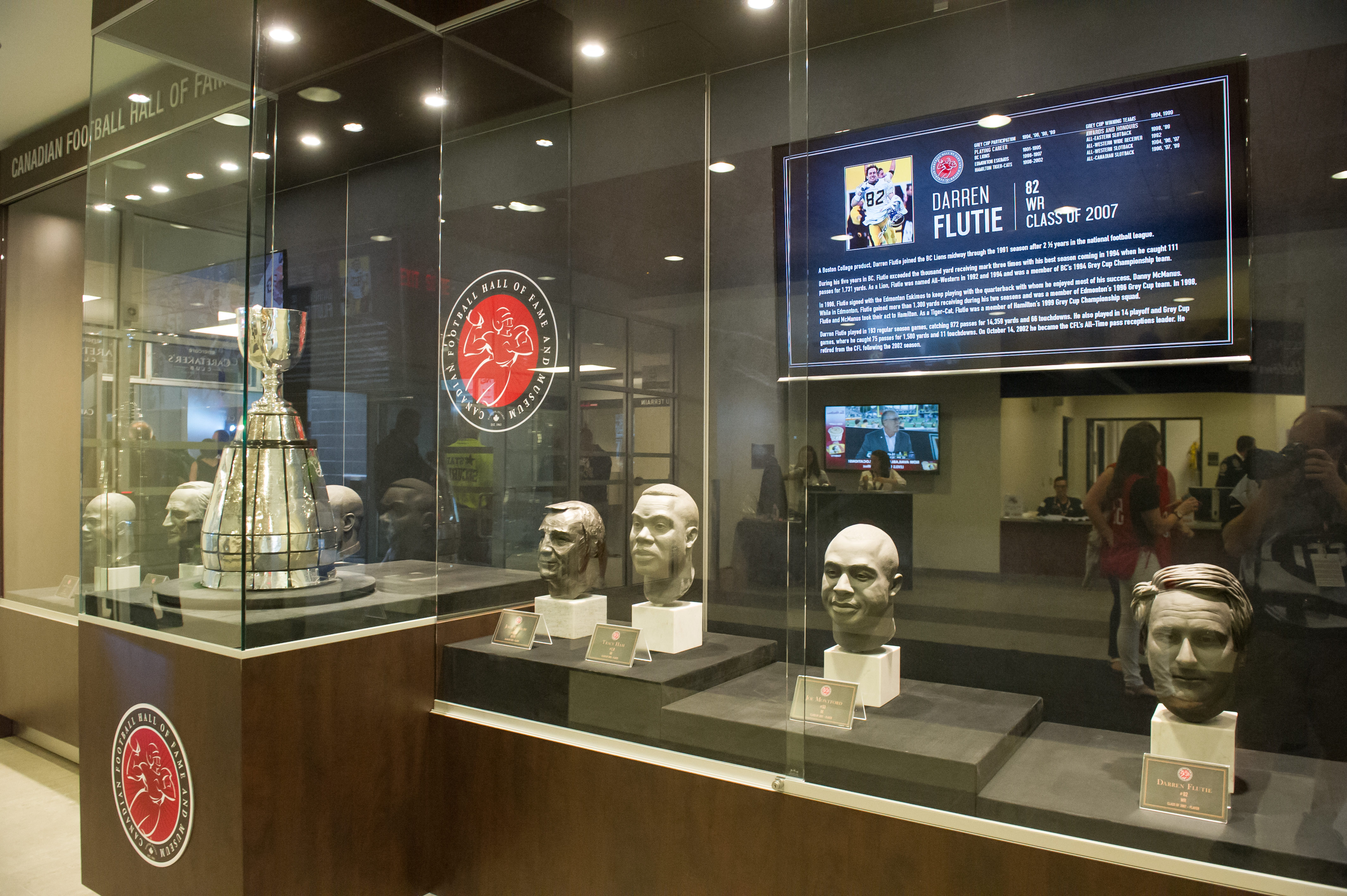
The physical location of the CFHOF isn’t the only way that Hamilton and the Hall are inextricably connected. Every year between 1972 and 2008, the city of Hamilton hosted the CFL’s Hall of Fame Game (HOFG), in which the current year’s inductees were honoured. In 2016, the HOFG returned to Hamilton, and it will repeat its appearance this season (2017).
The HOFG will make a roaring return, as the 2017 Hall of Fame Induction Class is star-studded to say the least. The group is comprised of just six members but the list of shared accolades is seemingly endless. The players that are up for induction in 2017 are Kelvin Anderson, Anthony Calvillo, Mike O’Shea and Geroy Simon. There are also two builders up for induction: Stan Schwartz and Brian Towriss. A ‘builder’ is any person that has made an outstanding contribution to Canadian football in any capacity other than player.
Schwartz served as an Assistant Coach and President of the Calgary Stampeders, as well as the Defensive Coordinator of the Calgary Mohawks junior team. Towriss had an enormous impact on the game at a collegiate level, coaching the Saskatchewan Huskies to nine Vanier Cup appearances and three national championships. He was a major producer of CFL talent throughout his career.
Anderson, one of the Calgary Stampeders’ great running backs, rushed for over 1,000 yards in eight consecutive seasons. He holds the record for consecutive 1,000 rushing yard seasons and set a benchmark that will be near-impossible to parallel.
Calvillo is professional football’s all-time passing leader, with 79,816 passing yards. Much like Wayne Gretzky or The Beatles, Calvillo’s accomplishments within his domain exist on an untouched pedestal.
O’Shea ranks second in all-time career tackles, trailing just Willie Pless, a 2005 Hall of Fame Inductee. O’Shea’s 1,151 career defensive tackles combined with his 169 career special teams tackles (seventh all-time) make him the most prolific all-around tackler in CFL history.
And finally, Simon is the CFL’s all-time receiving yards leader with 16,352 yards, second in professional football only to the NFL’s Jerry Rice.
The players in the CFL’s 2017 Induction Class are incredible talents and each is deserving of his Hall of Fame nod. The stories of just two however, are as deeply intertwined with the Hamilton Tiger-Cats, as the CFHOF is itself.

Calvillo started his Canadian football career in the unlikeliest of places: Las Vegas Nevada. During the mid-1990s, the CFL was facing a dire financial crisis and expanded south of the border, lured by the promise of potentially league-saving expansion fees. Expansion cities included Sacramento, Houston, Baltimore, Shreveport, Memphis, Birmingham, San Antonio, almost Miami (in an interesting twist, the CFL was nearly home to a team named the Miami Manatees), and Las Vegas. Calvillo played for the Las Vegas Posse (of all names) for the 1994 season, starting in 17 games.
The Posse had a dismal campaign. Average attendance hovered around the 10,000 mark, with crowds sparsely peppered throughout the more than 30,000-seat Sam Boyd Stadium. The team went 5-13 and one of its most notable moments was a particularly hilarious national anthem mishap in which the clueless anthem singer drawled what sounded like a patriotic O Christmas Tree. The only real highlight of Calvillo’s time in Vegas was a game against the Ottawa Rough Riders (for those who don’t remember, there was a time when two of the CFL’s nine teams shared a name) in which he passed for 551 yards as a member of the Posse. That performance remains tenth all-time in CFL history for most passing yards in a single game. It would also forecast the outstanding career to follow.
After the ill-fated American expansion suffered its inevitable collapse, the Posse tucked its tail and withdrew into the shadows of the Nevada night. Calvillo wasn’t yet the star he would eventually become, but his play in 1994 made him one of the dispersal draft’s brightest spots. The Tiger-Cats pounced on Calvillo, and he became part of his first true Canadian football team (one actually based in Canada). Calvillo started at quarterback for the Tabbies until a late-career Mike Kerrigan (the Ticats’ leading passer at the time of his retirement) returned to Hamilton for the second half of the season. Over the next three years, Calvillo built the foundation for a 20-year, hall of fame career. In three seasons with the Tiger-Cats he started 26 games and passed for 7,579 yards. Without the yards he amassed with the Ticats, Calvillo’s career total would drop to second all-time, just over 100 yards behind Damon Allen. Calvillo’s most statistically productive seasons were spent with the Alouettes, but his formative years, the seasons where he was molded into one of the greatest quarterbacks to play the Canadian game, were spent in Hamilton. Without those seasons, Calvillo’s Hall of Fame resume would be a little bit less impressive.
Calvillo’s impact on the game was so profound, that despite retiring in 2013, he still has an effect on the Tiger-Cats of today. Veteran offensive lineman Ryan Bomben broke into the league as a rookie Alouette while a veteran Calvillo closed out his career in the pocket behind him.
“He was a fantastic teammate,” says Bomben, speaking about Calvillo with noticeable respect. “He was always joking around. He kept things light, but he also knew when to stop joking. He always worked hard and studied. He was always the first guy there and the last one to leave.”
Calvillo had an impact on almost every CFL career during his era. Ticats General Manager Eric Tillman encountered him many times throughout his career, and as an opponent that didn’t always bode well for Tillman’s fortunes.
“Competing against a great player like Anthony wasn’t always fun, and, on a personal level, the 2009 Grey Cup was the ultimate example of that,” says Tillman. “Remember, we [Saskatchewan] went into the fourth quarter with a big lead, only to see one of the all-time remarkable comebacks, with the Alouettes scoring 18 points in the final eight minutes, and breaking our hearts in that 28-27 Montreal comeback win. That game and so many others during his remarkable 20 year career were examples of Anthony’s poise, decision making under pressure, and laser accuracy when big games were on the line.”
Tillman also praises Calvillo for his Hall of Fame personality.
“As a 10 time all-star, his playing career speaks for itself. But, what many of us respect most about Anthony is the man, husband, and father he is,” says Tillman. “The support and compassion he showed his wife Alexia during her fight with cancer was extraordinary. In that way, and so many others, he’s been a terrific role model to his daughters. No doubt, Anthony’s special – a true Hall of Fame player and man.”
Calvillo is unquestionably deserving of his Hall of Fame recognition, but there is another player in the 2017 Induction Class that has strong ties to the Tiger-Cats: Mike O’Shea. But, as Tillman argues, fans can sometimes find it more difficult to recognize the contribution of players that work on O’Shea’s side of the ball.

“Because our league tends to view the game through an offensive prism, great defensive players often don’t receive the full credit they deserve,” says Tillman.
Tiger-Cat fans know a thing or two about recognizing defensive greatness, and the city has seen more than its share of defensive Hall of Famers. O’Shea was one of the most dominant linebackers to wear black and gold, and that’s a difficult list to crack. Although the majority of his career was spent in double blue, his time with the Ticats will not go forgotten or unrecognized.
O’Shea earned his Canadian football start in Hamilton. He was drafted fourth overall by the Edmonton Eskimos but was quickly shipped to Hamilton in a trade. The Ticats had to pay big in order to acquire O’Shea, sending the CFL’s second all-time passing yards leader, Damon Allen, to Edmonton, in exchange for O’Shea and three other players.
O’Shea would not disappoint in his rookie season. He started all 18 games and recorded 86 total tackles split between defence and special teams. He would go on to top those numbers in his sophomore campaign, posting over 100 combined tackles. Despite starting on defence, O’Shea contributed on special teams for the entirety of his career. In his third season with the Tiger-Cats, O’Shea’s dominant play continued and he decided to take a shot down south at the conclusion of the season. He ended up being one of the final cuts at the Detroit Lions’ training camp, and although he returned to the CFL, he remained in blue, signing a mid-season contract with the Toronto Argonauts.
O’Shea and Hamilton would not be kept separate for long. O’Shea was reacquired by the Ticats and made an immediate impact after a few years spent with the Argos. He recorded 90 defensive tackles in the 2000 season, enough for third in the league that year. Unfortunately for the Tiger-Cats, he would again be claimed by the Argos in 2001, and go on to finish his career in Toronto.
Once again, Tillman had nothing but positive memories of the inductee, and this time around, he even had direct work experience to draw on.
“He was smart, tough, a leader of men, and had a rare work ethic on and off the field,” Tillman says. ”Being the best player and teammate he could be meant everything to him, and he was a critical component of those back to back championships [as a part of the Flutie-led Argos in 1996 and 1997]. Now, twenty years forward, we’re all proud he’s receiving this special honour. Being a Hall of Famer is a rare distinction, and one that Mike earned and very much deserves.”
And now, two well-deserving former Tiger-Cats, Calvillo, and O’Shea, will be enshrined in the CFHOF.
The CFHOF started in Hamilton. It was homeless for a time, then found, then closed down once again. Now, in the end, it’s back where it has always belonged: at Tim Hortons Field, the permanent home of the Hamilton Tiger-Cats.
Anthony Calvillo and Mike O’Shea earned their Canadian football starts in Hamilton. They moved around the league and found success in other markets, but now, after illustrious careers, they’re returning to where it all began, for a fitting end to two Hall of Fame careers.