The Hamilton Tiger-Cats under Head Coach June Jones operate an offense which is heavily layered with run and shoot concepts. In an earlier article on Ticats.ca, the run and shoot offence was broken down and presented from both an historical and modern day perspective. It is relatively easy to discuss the particulars of an offensive system, as offenses are run by detailed plans which are made up of specific plays determined and practiced well in advance of the game. Although plays are determined in advance, play selection is dictated by the down, the required yardage, the score of the game, the play of the opposing defence, and a host of other variables.
For example, Coach Jones has stated that prior to the start of a game he decides on a specific number of scripted run plays and ensures he meets that number during the game. However, it is unlikely that Coach Jones would choose to run the ball on second-and-twenty, especially if he’s trailing in the fourth quarter.
Ultimately, the offence has possession of the ball, so its decisions dictate the play, but the game situation dictates the offence’s play call.
Things become murkier still when the conversation turns to defensive strategies. On the defensive side of the ball, things are not as cut and dry as run and shoot. Defensive coordinators, such as Phillip Lolley of the Hamilton Tiger-Cats, are required to be reactive and mold their strategies and play-calling to counteract the opposing offence’s schemes and exploit its tendencies.
It’s more difficult to break down a team’s defensive strategy, but let’s give it a shot anyway.
“It all goes back to the fundamentals really,” said Lolley, following his promotion to defensive coordinator. “Getting lined up, knowing your assignments, guys that break on balls, and get there [to the ball].”
According to Lolley, it all starts with alignment.

“Get lined up first of all,” he said. “Don’t beat yourself with things you know.”
Typically, defensive alignments are named by the number of players split between the defensive line and the linebackers. The base defence in the CFL is a 4-3 defensive alignment. The four represents the number of defensive lineman one-yard off the line of scrimmage, and the three represents the number of linebackers lined up behind them. There can be a number of different permutations of this base defence, including a 3-4, or 5-2 to name a couple.
Sometimes, defences will choose to load ‘the box’: an area three to five-yards deep on the defensive side of the line of scrimmage which spans the width of the offensive line. In a 46 Defence, teams will cram eight players into the box, with six lining up one-yard off the line of scrimmage and two linebackers just behind them. When a team loads the box, it’s usually an aggressive play where they want to bolster the pass rush and pressure the opposing team’s quarterback. When five or more players join in the pass rush, it’s called a blitz.
In a base defence (four defensive lineman, three linebackers), linebacker is commonly the position which joins the blitz, although it isn’t uncommon for defensive backs to jump in as well.
In the first quarter of the Tiger-Cats week 15 matchup vs. the Argos, Toronto quarterback Ricky Ray marched his offence down the field and was threatening to score. With the Argos firmly in the red zone, Coach Lolley called for an eight-man blitz. All four defensive lineman, all three linebackers, and one defensive back – in this case, Demond Washington – were called upon to pressure the quarterback. The Argos had six players on the line of scrimmage and one player in the backfield to aid in pass protection. Eight men blitzing and seven men blocking leaves one man unblocked. Washington shot around the edge and leveled Ray for the sack.
Other times the defence will take a preventative approach. In week 14 in BC, there were still ten seconds remaining on the clock after Sergio Castillo hit the go-ahead field goal. Ten seconds was just enough for the Lions to run a single offensive play. On this particular play, the Ticats elected to run a four-man pass rush and drop every linebacker into coverage.
This defensive alignment is called a ‘prevent defence’ because six or more players lined up as defensive backs. Under normal circumstances, there are five defensive backs in Canadian football, and a prevent defence requires at least one linebacker to drop into the secondary. In the above case vs. BC, all three Tiger-Cat linebackers dropped into coverage. This defensive alignment was clearly illustrated on the television broadcast. When BC snapped the football, four defensive linemen were the only Ticats visible in the frame; the rest were too far downfield to be seen.
These examples illustrate that the pre-snap alignment is important, but what about after the snap?
After watching game tape and talking to both Coach Lolley and the players who play under him, it becomes clear that the philosophy of the Ticats’ new defensive coordinator may be summed up in the following key words.
TOUGHNESS
“Just old school and rugged. Tough,” said Ticats’ first-year defensive tackle Davon Coleman when asked to describe Coach Lolley’s coaching philosophy.
And Coleman isn’t the only Ticat who recognizes that Coach Lolley expects toughness from his players.
“Hard-nosed, tough,” said Ticats’ safety Courtney Stephen. “It’s real football. No sugar-coating. When it’s time to cover, you cover. When it’s time to tackle, you tackle. Do your job, be accountable, and just be tough about it.”
SPEED
Much like Coach Jones on the offensive side of the football, Coach Lolley likes his players fast.
Cornerback Don Unamba joined the Tiger-Cats partway through the 2017 season. He came into a winless locker room, but he didn’t feel like he was joining a slumping team. He felt like was joining a team full of energy, belief, and speed.
“We play it hard, fast; everybody gets to the ball,” said Unamba. “We don’t really care what the other team is doing. We’re going to play our philosophy defence. We’re going to dictate what you do and what we give up, and we’re going to continue getting to the ball as fast as we can.”
Coleman has been with the Tiger-Cats since the start of the season, and he also notices Lolley’s affinity for speed.
“He wants us to play fast,” said Coleman. “It’s not that much thinking involved and you just play fast.”
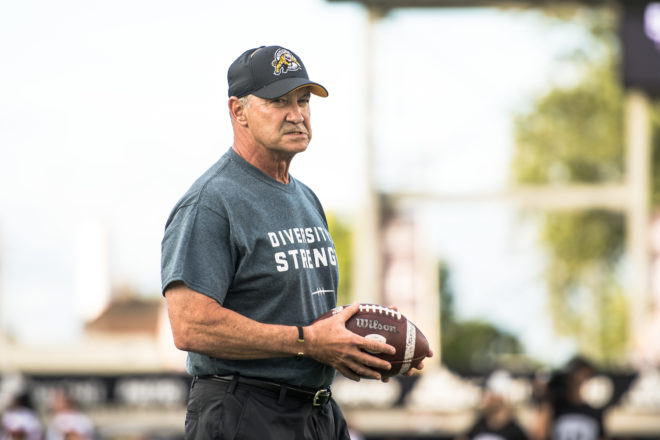
Coleman’s quote sets up the next trait of Coach Lolley’s defence:
SIMPLICITY
Coach Lolley is a man who preaches the fundamentals.
“I know how I am, and I am a very fundamental guy, pretty simple,” said Coach Lolley. “Some of the better championship teams that I’ve been around and been on – and I was telling the players this the other day – it was very simple stuff. Very simple playbooks. Very simple terminology. Because when the ball is snapped, all that other stuff goes out the window. It’s kind of like what Mike Tyson said, ‘when everybody’s got a plan, you get hit in the mouth.’”
The players are buying into his no-nonsense, direct approach to football.
Unamba also believes simplicity benefits speed.
“We just get to the ball,” said Unamba. “We took some things away, did some things differently. We don’t have to think as much. We play it hard, fast, and everybody gets to the football.”
Coleman agrees with Unamba, as he added, “Oh yeah, I love that. I just want to play football.”
COMRADERY
The final key to Coach Lolley’s defence is the locker room comradery.
“Guys are just finding their niche,” said Ticats’ middle linebacker Larry Dean. “Everybody is banding together, gelling. So that’s one of the biggest contributors: guys gelling together and being able to communicate and speak the same language.”
Unamba was surprised by the comradery when he came to Hamilton from Montreal.
“I thought it was going to be dead, and everybody was going to be in a slump,” Unamba said. “You would never believe that this team was a winless team. So that was a shock. And in the past weeks, the way we came together. Getting wins was a big morale boost for us. Everybody is getting closer and closer. The chemistry is getting right, on the field and off the field.”
And the comradery in the locker room extends to the field of play as well.
“We have this term that’s called, ‘Save the Family,’” said Stephen of the Ticats’ on-field mentality. “Everybody goes and attacks and somebody gets back and makes sure they ‘Save the Family’. That means if anything bad happens, you know somebody’s got you.”
And that chemistry extends to Coach Lolley himself.
“I’m a guy that walks out there and says, ‘let’s go sick ‘em.’ I don’t tell them to sick ‘em. I say ‘let’s go sick ‘em,’” said Coach Lolley.
A lot can be said about how a team plays football, but the real results are found on the stat sheet. In Coach Lolley’s time with the Tiger-Cats, the stats are looking good.
With Coach Lolley as defensive coordinator, the Tiger-Cats concede an average of 80.14 rushing yards per game. If those numbers were extended to apply to the entire 2017 season, the Ticats would rank second in the CFL behind just the Calgary Stampeders.
Coach Lolley’s defence has also succeeded in limiting the opposing team’s passing attack to just over 300 yards per game and fewer than two passing touchdowns per game.
Considering the stats, it becomes evident: whatever Coach Lolley is doing, it’s working.
Larry Dean may have summed up his style of play under Coach Lolley best when he said, “See ball, get ball. You would think there’s something more to it, but that’s pretty much the thing.”
- Labour Day Classic
- Content & News
- Tickets
- Schedule
- Team
- Gameday
- Shop
- MyTix
- Community & Events